
Industry events · 7 min read
IMN Multifamily Southern California Review: Is It Worth It? (2026)
A first hand review of IMN Southern California Middle Market Multifamily 2026. What the attendance really looked like, who goes, session quality, and who should attend.
On this page
By Andreis Bergeron, Head of GTM & Partnerships at Brickwise. I went to both days.
The short answer
IMN Southern California is a capital markets conference with one property management panel tucked in. If you own multifamily, lend on it or invest in it, two good days. If you run a property management company and want to get better at running it, this is the wrong room. If you sell to owners or capital, it can work. If you sell to property managers, there are not many of them to meet.
The venue was beautiful and the people were friendly. Most of the sessions stayed at 30,000 feet, and I did not walk out with much I could use. The exception was the state of the market presentations.
"Most of the sessions were high level strategy without much to take away."
"The state of the market presentations were helpful if you're looking to see how the market is shifting from an acquisition standpoint. They also highlight some good best practices to get the gears turning."
Quick facts
Fact | Detail |
|---|---|
Event | IMN Southern California Middle Market Multifamily Forum |
Organizer | IMN, part of Informa Connect |
Dates | September 15 to 16, 2026 |
Location | Rancho Bernardo Inn, San Diego, on a golf course |
Published attendance | "400+ players" per IMN. No exact count |
What I saw | One session room with roughly 50 to 100 people and a vendor hall of about 10 vendors |
Agenda | 15 content sessions: about 10 on day one, 5 on day two |
Property management sessions | 1 panel |
Ticket price | Not shown on IMN's event page |
Next edition | September 2027, San Diego, venue to be announced |
How many people were there?
IMN's page says "400+ players from across middle market multifamily." It does not publish a registration number.
What I saw was smaller. Every session ran in one room, and I counted roughly 50 to 100 people in it. The vendor hall had about 10 vendors. I can't make those two numbers agree. Some people may have been in the invitation only VIP sessions for investors, operators and owners. An ADU conference also ran at the same venue, which confused me at first, though it did put a few more real estate operators around.
If you are deciding based on size, plan for a room of about 100, not 400.
Who attends
IMN lists seven attendee groups: owners, operators and developers; investors and equity providers; property managers; lenders and brokers; insurance, legal and advisory firms; technology, proptech and AI companies; and amenity and service providers. It publishes no percentages.
It did publish 84 company names from the 2026 event. Sixty are filed under owners, operators and investors, and 24 under other multifamily firms, mostly vendors and service providers. Going through the 60 by name, I can pick out only a few property management operators: Greystar, RPM Living and Kairoi. Most of the rest are funds, lenders, developers and capital firms like Carlyle, Invesco and Tricon.
That matched what I saw in the room. Mostly owners and capital providers.
For a fuller split, I classified the attendee lists IMN shared for its Texas, Florida, Southeast and Carolinas multifamily events. They are not the San Diego event, but the format and audience are the same. Across 691 companies:
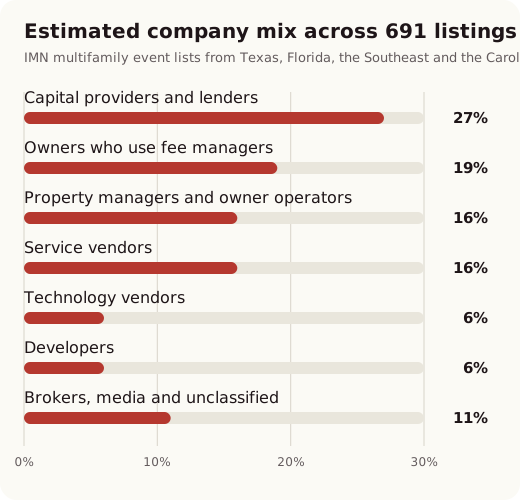
- Capital providers and lenders: about 27 percent
- Owners who use fee managers: about 19 percent
- Property managers and owner operators: about 16 percent
- Service vendors: about 16 percent
- Technology vendors: about 6 percent
- Developers: about 6 percent
- Brokers, media and unclassified: about 11 percent
Only about 16 percent were property managers or owner operators. Owners and capital providers outnumbered them by a wide margin. I sorted these from company names and job titles, so treat the split as an estimate.
The sessions
At least six of the 15 sessions on the published agenda were about capital, debt, underwriting or deal strategy:
- Where experienced capital is headed in SoCal
- Debt financing through the cycle
- Underwriting multifamily in today's market
- Distressed opportunities and workouts
- How investors decide on equity allocation
- Why middle market multifamily is more profitable than larger deals
The rest covered insurance and climate risk, value add and workforce housing, and affordable homeownership. One panel covered property management in Southern California: execution, compliance and the onsite reality.
Two slots were about AI: a 45 minute PropTech and AI showcase on day one, and "From Pilot to Portfolio: AI Execution Case Studies" on day two, with an acquisitions case study from Dunleer and NextRivet.
Quality was uneven. Most sessions were broad and strategic, with little you could use Monday morning. The state of the market presentations were the useful ones. They show how the market is shifting from an acquisition standpoint, and they gave me a few best practices to chew on.
Who speaks
Most agenda slots had no speaker names published. From the names that are, the speakers fall into a few types:
- Research and advisory firms. Zonda Advisory opened day one with a market presentation
- Lenders, such as Lument
- Large institutional operators: RPM Living, Greystar, Kairoi
- Asset managers and investors: First Empire, CCI Invest, Veritas Investments
- Government, in the form of California Assemblymember Buffy Wicks
- Consultants and vendors: NextRivet, RUCKUS Networks
The sponsors lean toward capital too. Walker & Dunlop was the gold sponsor. The bronze list includes lender Lument, insurers Gallagher and HUB International, and Conservice.
What I took away
- The hallway beat the stage. I came away with 18 real conversations over two days, nine with operators and nine with partners and service providers. Almost all of them started in the hallway, not in a session.
- The event app did not work for me. I sent 157 direct messages through it and got three replies, which turned into one meeting. People standing in a hallway ignore their phones.
- Unit count is a weak signal. Some companies claimed thousands of units but sat on the capital side and never touched an operating system. The better question is whether they run property management themselves or pay someone else to.
- If you sell to owners, the attendee mix helps you. Owners are the people who hire and fire property managers, and this is a decent room to meet them.
Is IMN worth it for owners and operators?
Owners and investors: yes. This is your room, and the state of the market presentations and capital panels are built for you.
Lenders and capital providers: yes. They were the biggest group in the attendee lists.
Property managers and operators: probably not as your main event. You get one panel. It can work if you want to meet owners who might hire a manager. If you want to learn how to run a management company, go to NARPM instead.
Is IMN worth it for vendors, technology companies and service providers?
It depends on who your buyer is.
If you sell to owners or capital, such as insurance, tax, lending, amenities, connectivity or access control, yes. The sponsor list is full of companies like that, and their buyers are in the room.
If you sell to property managers, there are few of them here. On my own target list of 63 attendee companies, only 31 were real operators who run their own properties. The rest were owners who hire a third party, or capital firms.
The vendor hall is small, about 10 vendors, so you will not get lost and you will not get volume either. IMN also runs a limited availability innovation demo tour and the PropTech and AI showcase. I gave one live demo on the floor.
Before you go, ask each target one question: do you run your own property management, or does someone else?
FAQ
IMN advertises "400+ players" and publishes no exact count. In 2026 I saw roughly 50 to 100 people in the session room and about 10 vendors.
Rancho Bernardo Inn in San Diego, September 15 to 16, 2026. IMN lists the 2027 edition as September 2027 in San Diego, venue to be announced.
For most, not as the main event. Property management got one panel across two days. It suits owners, investors and lenders better.
Yes if you sell to owners or capital. Only about 16 percent of attendees in the IMN lists I classified were property managers or owner operators, so it is a thin room for software or services aimed at property managers.
Owners, developers, investors, lenders, brokers, advisors, vendors and some operators. IMN publishes no percentages. In the lists I classified, about 27 percent were capital providers and lenders and about 16 percent were property managers or owner operators.
IMN lists Southeast (May 28 to 29, 2026), Florida (February 10 to 11, 2027), Texas (March 23 to 24, 2027), Pacific Northwest (August 26 to 27, 2027) and Carolinas (October 13 to 14, 2027).
IMN does not show delegate pricing on its public event page. Ask the organizer.
About this review
I went as Brickwise's Head of GTM & Partnerships. Brickwise builds Alice, an AI agent that works on top of the property management system you already run and handles lead to lease, maintenance triage, rent collection and compliance. That is my angle. The observations are mine. The published facts come from IMN's event, agenda, sponsor and attendee pages at informaconnect.com/imn-multifamily-california.
Written by
Andreis Bergeron, Head of GTM & Partnerships
28 October 2026 · 7 min read
